

Rail foundation basics
A heavy gantry only cuts as straight as the rails and the concrete under them. Long rail runs in steel service centres, mines and structural shops depend on the right slab thickness, anchor spacing and alignment control.
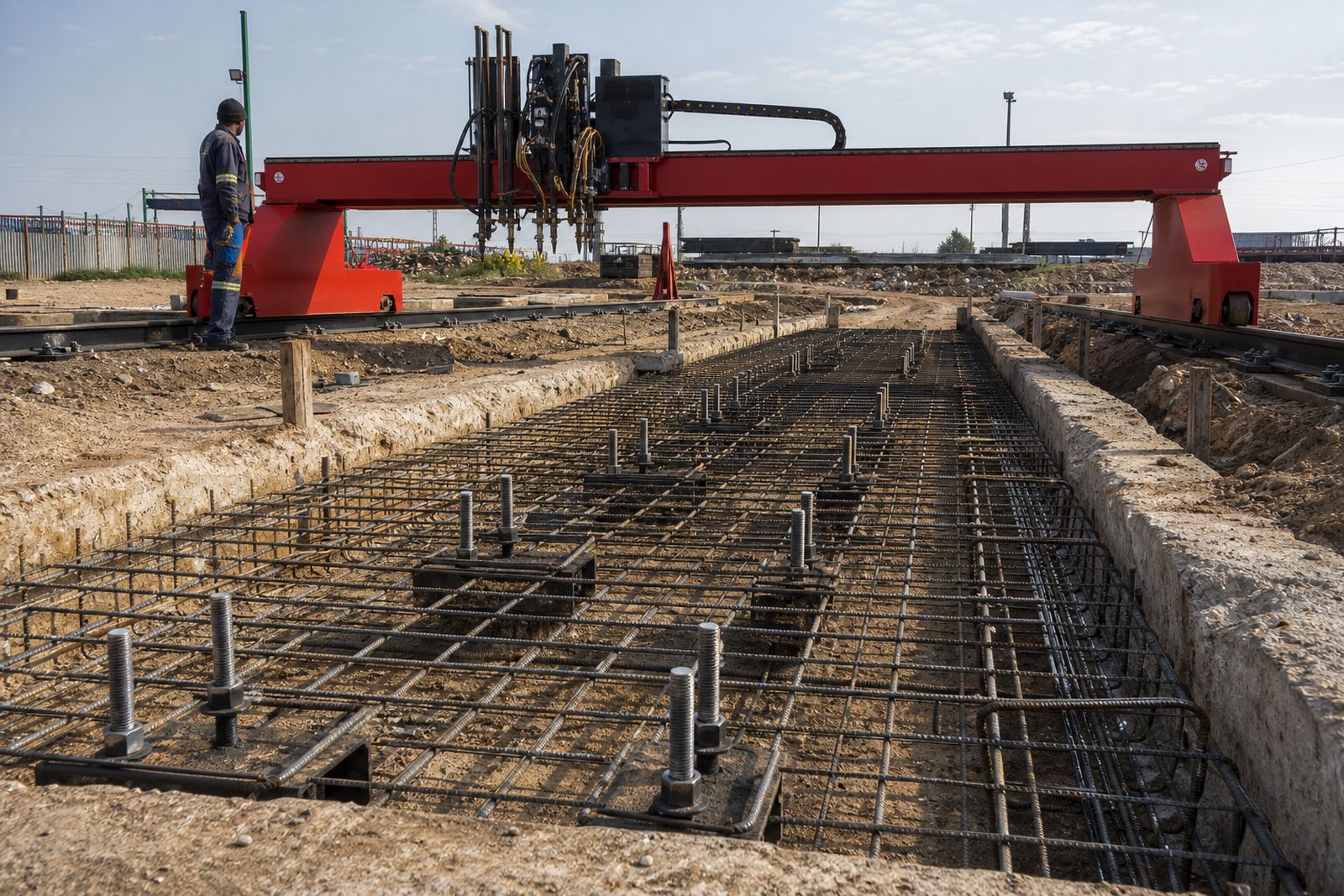
Start with the load and the machine layout
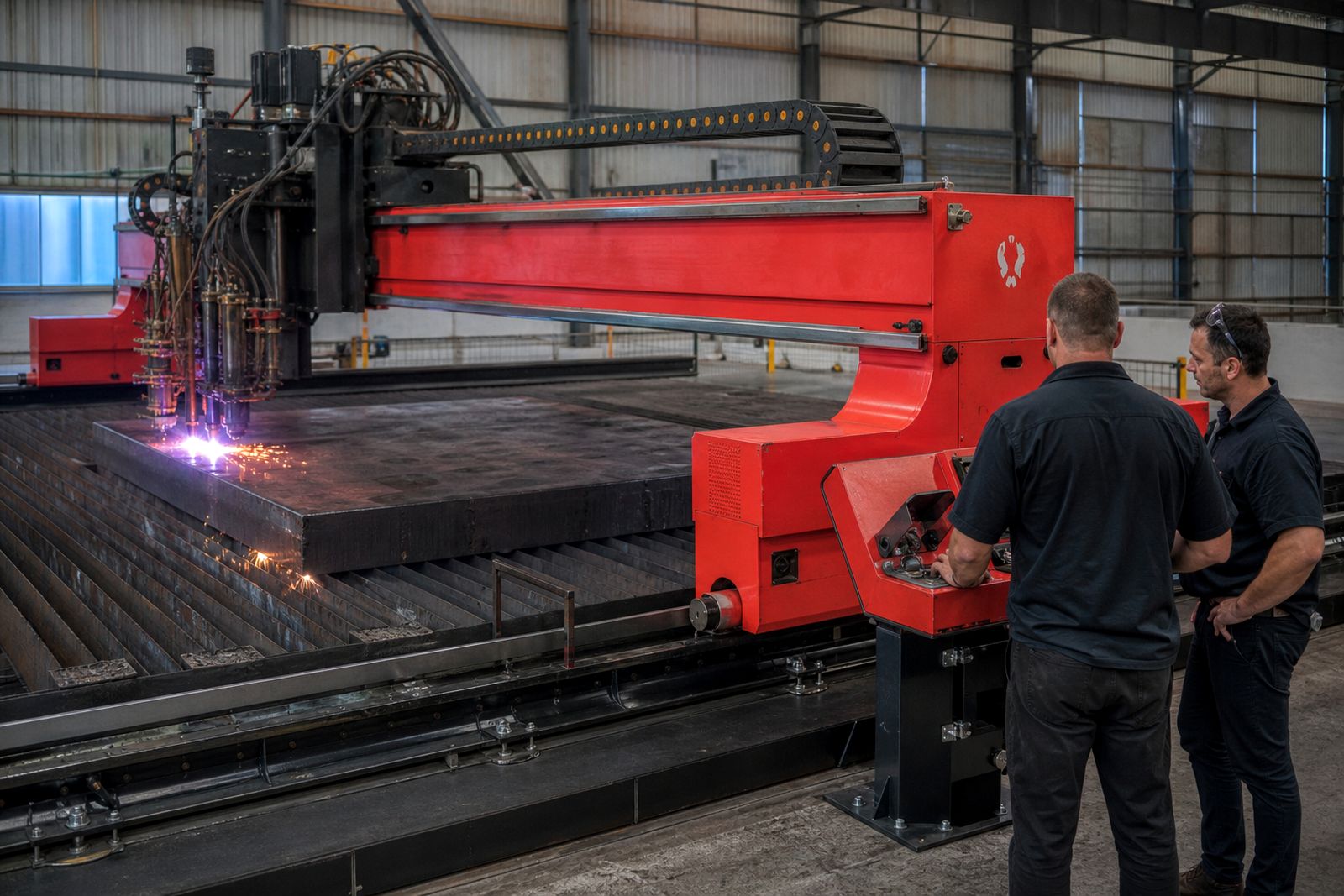
Rail foundations for a 1.5 metre gantry are not judged the same way as foundations for a 5 metre or 7 metre machine. The wider the bridge, the longer the rail run and the heavier the moving mass, the more the floor build matters. A rail line that looks acceptable over 3 metres can show real trouble once it carries over 18 metres, 24 metres or longer.
Before concrete dimensions are set, we look at gantry width, rail span, expected plate thickness, loading method and whether the table sits inside a busy service centre or a quieter fabrication bay. Forklift traffic nearby, overhead lifting, floor joints and drainage slopes can all affect rail stability. The rail foundation must hold the rail down and keep both sides true to one another under working conditions.
- Confirm gantry width and the planned cutting length.
- Note whether the machine is single-drive or dual-drive.
- Record plate loading direction and crane access.
- Check for existing floor joints under the rail path.
- Allow space for cable routing, service access and end stops.
Slab thickness has to suit the rail run
There is no single slab thickness that suits every heavy gantry. A short run in a controlled bay may accept a different build to a long rail pair next to vehicle movement and regular plate handling. What matters is a stable foundation with enough depth and reinforcement to resist cracking, edge failure and local movement around anchor points.
On long rails, thin surface slabs often cause more trouble than the rail hardware itself. Small deflection under one anchor row can twist the machine line over distance, and that shows up as poor parallelism, torch height inconsistency and extra wear on wheels or guide assemblies. If the machine is being installed into an existing works, we check whether the old floor was poured for traffic only or whether it can actually carry a precision rail line.
We size each foundation around the rail length, bridge weight and the slab already on site. In some shops a new reinforced strip footing is the right answer, while in others an isolated rail beam arrangement works better. The machine foundation must suit the machine layout and site conditions.
Anchor spacing affects stiffness and service life
Even with a sound slab, poor anchor spacing can leave sections of rail working loose over time. On heavy gantries the anchor pattern must hold the rail evenly, without long unsupported gaps that allow lift or side movement. Spacing is set to the rail section, the expected travel loads and the condition of the concrete below.
Too few anchors can let the rail line creep out of tolerance. Too many, placed badly, can create stress points in weak concrete or near slab edges. We look for a pattern that spreads clamp force consistently along the full machine travel. Rail joints, transitions and end zones normally need closer attention because those spots take repeated load and braking forces.
- Keep anchor lines clear of cracked or honeycombed concrete.
- Watch edge distances where rail beams are narrow.
- Check pull-out strength against the concrete condition on site.
- Review joint areas and machine end stops carefully.
- Allow access for tightening, inspection and later maintenance.
Tolerance on long rails is where jobs are won or lost
A gantry can have a sound bridge, decent drives and a capable torch package, but it still will not track properly on rails that wander. Long rail runs need practical measured tolerances for straightness, level and parallel spacing between the two sides. The longer the machine bed, the less room there is for casual floor work.
On site, the full run must stay within tolerance from one end to the other, and both rails must agree with each other. A rail line can be level and still be wrong if the opposite side is not parallel. That is where racking, skewing and cut inaccuracy start to show.
We install and align rails with the full travel in mind, including acceleration zones and machine ends. Final checks are done before and after fixing, because tightening anchors can shift a rail slightly if the support below is uneven. A careful install saves many later hours of fault finding, and that's usually where the value sits.
Site checks before concrete and before rail installation
Foundation trouble often starts well before the gantry arrives. A floor walk can miss the details that matter, especially in older steel plants where surfaces have been patched, cut and repoured over time. Two check stages help. The first is before any concrete work starts. The second is after curing and before the rails are brought in.
- Check floor levels across the full machine footprint.
- Mark existing cracks, saw cuts and service trenches.
- Confirm that water run-off will not track through the rail path.
- Measure clearances to columns, walls and plate staging areas.
- Inspect concrete finish and actual anchor zones before drilling.
- Verify that lifting equipment can place rails without twisting them.
In coastal conditions, moisture and corrosion protection need more attention, particularly where steel fixings sit low to the floor and cleaning water is common. Inland mining and fabrication sites may have less humidity but more dust, vibration and heavy traffic around the installation area. The foundation detail should match the working environment and the actual site conditions.
When to rebuild, extend or leave the old slab alone
Not every existing floor should be reused for a new heavy gantry. If the slab shows widespread cracking, poor cover, weak edges or movement across joints, it can cost more to chase alignment later than to build the right support at the start. On the other hand, a sound floor with the correct depth in the right place can sometimes be adapted with local works and proper rail support detail.
Extensions need care too. Adding metres to an existing rail line requires a new section that matches line, level and stiffness. Otherwise the machine will feel the change at the transition. That can affect tracking and long-term wear even if the join looks neat on the day.
For heavy industrial gantries from 1.5 to 7 metres wide, foundation decisions should be taken alongside machine engineering and installation planning. If your site team is working through a new rail base or an upgrade to an existing bay, send the layout and floor details through our contact form so we can review the practical constraints from the start.
Questions we get asked
Can an existing workshop floor be used for a gantry rail installation?
An existing workshop floor can sometimes be used, but only after the floor condition, depth, joints and anchor zones have been checked against the machine layout. A precision rail line needs a slab that can hold alignment under load.
Does a longer rail run need tighter alignment control?
Small errors grow over distance, so straightness, level and parallel spacing become more critical as the rail length increases.
Do both rails need the same foundation detail?
They need matching stability and alignment control. The exact build can vary if site conditions differ from one side to the other, but the machine still needs both rails to stay true as a pair.
Also worth a look
Tell us about the job
Send sizes, materials and where you are through our contact form, and we will come back with the practical options.
Open the contact form