Wireless pendants for long gantries
On a long rail, walking back to the main operator stand for every jog, reset or position check wastes time and breaks flow. A wireless pendant puts machine movement and key operator functions in hand at the far end of the gantry.
What the wireless pendant changes on the machine
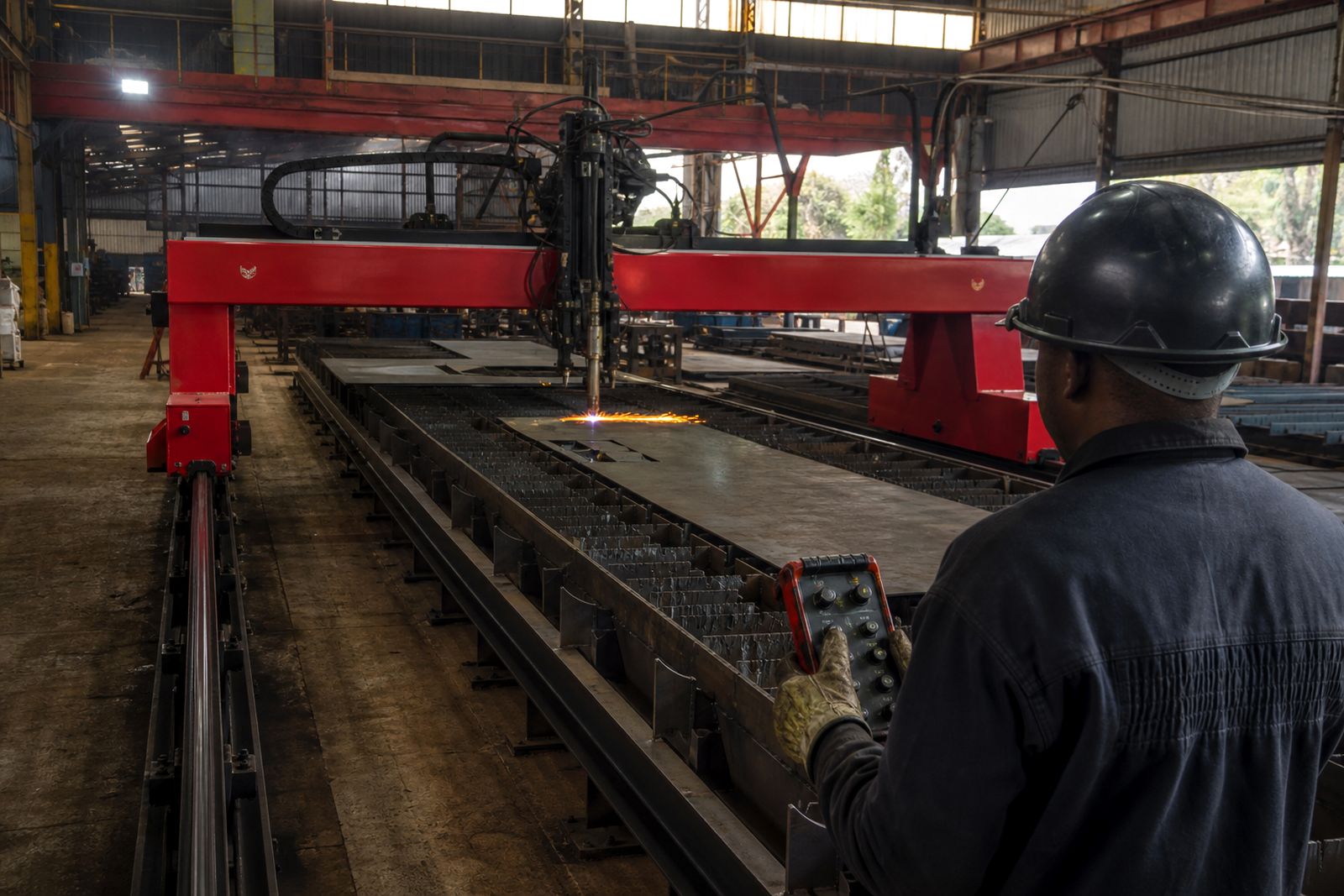
The pendant adds remote machine control for operators working away from the fixed stand. On a gantry running over 20 to 30 metres of rail, that matters during sheet alignment, torch positioning, dry runs and checks at the far end of the table. Instead of crossing the full rail length to jog an axis or return the gantry, the operator can work from the side where the task is happening.
On these heavy systems the pendant supports movement, positioning and selected machine functions under the setup agreed for the installation. The main control remains the centre point for programming and system status, and the remote unit cuts out a lot of walking that adds no value to the shift.
- Jogging gantry travel along the rail
- Cross travel positioning of the torch carriage
- Start, stop and hold functions where configured
- Return moves during alignment and setup
- Operator movement from either side of a wide table
When it earns its place
This option is worth paying for when the rail is long enough that operator travel becomes part of the job cost. That point is usually reached on larger beds handling structural plate, repetitive nests, multi-torch work or sections where setup checks happen at both ends of the machine. On a 30 metre rail, even a few extra walks per cut cycle add up over a full shift.
Sites with overhead handling, noisy fabrication bays and large plate stacks also get value from a remote pendant because the operator can stay closer to the cutting area and the crane handover point. In steel service centres and mine fabrication shops the value comes from reduced operator movement, shorter setup time and fewer interruptions to a sequence that is already under way.
- Long rails where the fixed stand is often out of reach
- Wide gantries with frequent side-to-side checks
- Multi-torch layouts needing setup from more than one position
- Heavy plate work where alignment is checked at the load end
- Teams running repeated nests across long sheets
How it is fitted and set up
The wireless pendant is fitted as an integrated option within the machine control arrangement. We match the pendant functions to the gantry layout, axis control logic and travel limits of the machine. On dual-drive gantries, correct setup matters because the operator is controlling a large moving structure and the travel behaviour must remain predictable over the full rail length.
Commissioning includes pairing the pendant, assigning permitted functions, checking range across the installed rail length and testing response in the actual workshop environment. Steel racks, plate packs and building structure can affect radio behaviour, so the check is done on site rather than guessed from a catalogue line. Operators are shown where the pendant helps, where the fixed stand must still be used and how to park or carry the unit so buttons are not pressed by accident.
Where the site has high electrical noise from other equipment we allow for that during setup, and a proper test run is done before handover.
Compatibility with our gantry range
This option is intended for heavy industrial gantries, especially the longer machines in the range. It is commonly specified on wider systems with long rails, but can be added to other builds where the working pattern justifies it. Compatibility depends on the control layout, drive arrangement and the machine functions that need to be available remotely.
- Suited to single-drive and dual-drive gantries where remote jogging is useful
- Often paired with wider machines from 3 m upward and long rail runs
- Can be used with multi-torch layouts where setup is checked along the full width
- Needs integration with the installed control package and safety logic
- Specified during machine build or planned as a retrofit after inspection
For existing machines, a retrofit depends on control cabinet space, available inputs, pendant mounting and the condition of the present operator controls. Not every older installation is worth modifying, so we assess the machine before recommending the option.
Common mistakes on long-rail installations
The most common mistake is ordering the pendant for a machine that is rarely operated from the far end. If the table is short, the stand is central and the operator mostly stays in one bay, the money is better spent elsewhere. It improves movement and handling on a large machine, with remote control of selected functions where the work is happening.
Another issue is poor carrying practice. Operators leave the pendant on a rail, plate stack or control box, then spend time looking for it or expose it to impact. A proper storage point and routine matters. On dusty fabrication floors the housing and buttons also need ordinary cleaning so controls remain clear and positive.
Finally, range assumptions cause problems. A long clear workshop and a packed steel bay behave differently, so on-site testing is part of getting the option right.
Operational detail that matters on the floor
On a machine cutting long plate, small handling improvements are often more useful than another feature list. A pendant helps when the operator is checking a lead-in near the far stop, moving the gantry after a plate change or aligning for the next cut while standing where the crane has just dropped material. That sounds minor but over a week it removes a lot of dead steps.
For workshops in Gauteng, Mpumalanga, the North West, KwaZulu-Natal and the Northern Cape, local floor conditions differ. Heat, dust and long building spans are normal on many sites, so the remote needs to be specified as part of the machine and tested in the actual bay where the gantry will run. That is where the option proves its value or it does not.
What our Gantry Plasma System customers say
Verified Google reviews
Questions we get asked
Does the pendant replace the main operator stand?
The fixed stand remains the main point for programming and full machine control. The pendant is used for remote movement and selected operating functions on long gantries.
Is it only useful on the largest machines?
It is most useful where rail length makes operator walking a routine part of setup. Many shorter machines do not need it, while longer rails and wider tables usually benefit more.
Can it be added after the gantry is installed?
In many cases yes, but only after checking the control layout, safety logic and available integration points on the installed machine.
Also worth a look
Tell us about the job
Send sizes, materials and where you are through our contact form, and we will come back with the practical options.
Open the contact form